Blog/Eye Tracking Cost
Research Methods

Eye Tracking Costs $5,000–$40,000 Per Study. Here's What the $0 Alternative Actually Gets You

Heatpoints Lab·8 min read

A lab-grade eye-tracking study is the most credible attention data money can buy. It's also a $5,000–$40,000 line item that takes four to eight weeks to deliver. Before you approve that budget — or skip attention testing entirely because of it — it's worth knowing exactly where the money goes, and how much of the result a free predictive model can replicate.

This isn't a methods deep-dive — we already wrote that comparison. This is the money question: what does each dollar of an eye-tracking study actually pay for, and which of those dollars can you keep?

Where the $5,000–$40,000 actually goes

Eye tracking's price tag isn't one number — it's a stack of four, and the biggest one is rarely the hardware.

  • Hardware: A screen-based research tracker runs $5,000–$50,000 to own. Most teams rent one or book an agency's lab instead, which converts the capital cost into a per-study fee — typically a few thousand dollars.

  • Participants: Quantitative attention claims need 30–50 participants. Incentives run $50–$150 per person, plus recruitment agency fees on top. Need a specialized panel — surgeons, procurement managers, day traders? Multiply everything.

  • The lab itself: Controlled lighting, calibrated displays, a quiet room, a moderator running one session at a time. Facility and session time is a real budget line, not overhead.

  • The analyst: The most underestimated item. Raw gaze data is a firehose of coordinates. Someone has to define areas of interest, clean the data, run the statistics, and write the report — typically 4–8 weeks of researcher time, and often the single largest cost.

Analyst & researcher time (4–8 weeks)14,000 $
Panel: 40 participants + recruitment6,500 $
Hardware access (rental or amortized)5,000 $
Lab facility & session time3,000 $
MID-RANGE LINE ITEMS FOR A 40-PARTICIPANT LAB STUDY. FIGURES FROM THIS ARTICLE. ILLUSTRATIVE.

Add it up and a lean study lands around $5,000; a full quantitative one with a recruited panel and proper analysis sits closer to $15,000–$40,000. And the money isn't even the whole cost: by the time the report arrives, 4–8 weeks later, the design you tested is often two sprints old.

What the $0 alternative replicates well

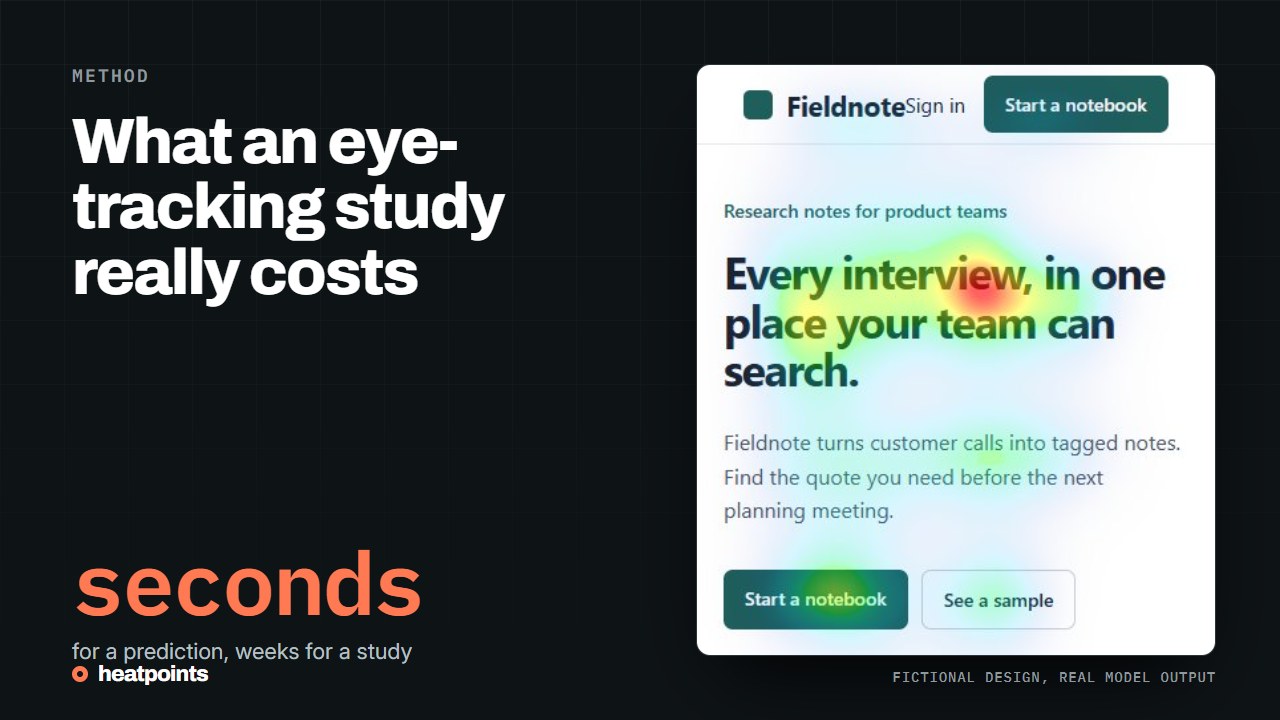
Predictive attention models are trained on exactly the kind of gaze data those labs produce. Given a screenshot, they output a probability map of where eyes land in the first moments of viewing — the involuntary, pre-conscious pass that decides whether your headline gets read and your CTA gets noticed.

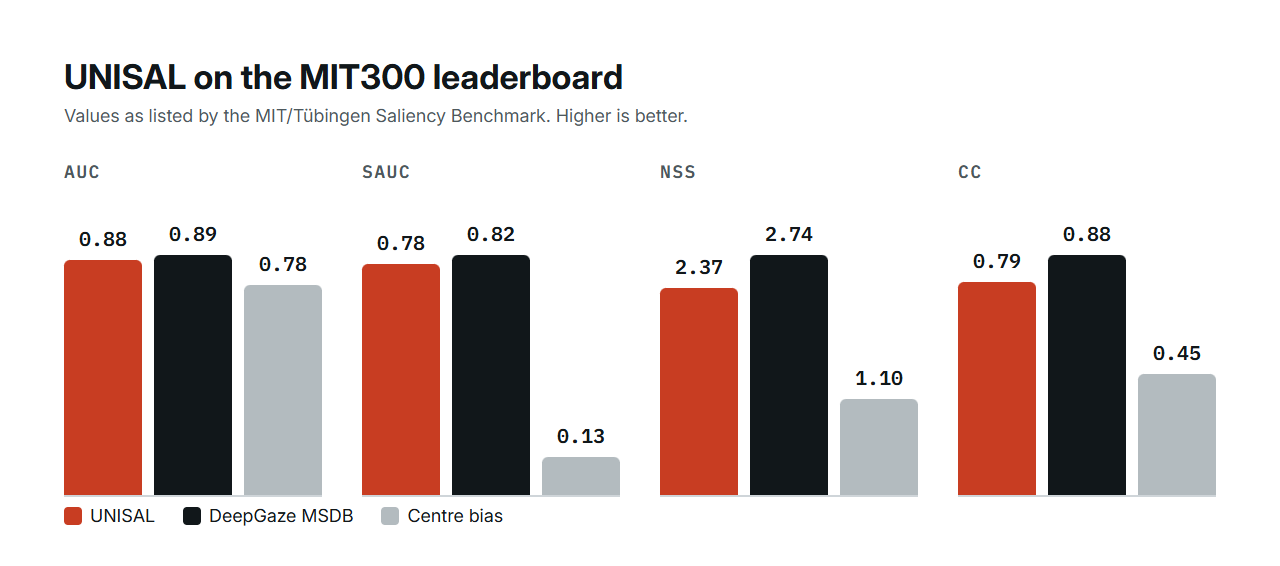
How well? On MIT300, the standard public saliency benchmark, UNISAL — the model behind Heatpoints — scores an AUC-Judd of 0.872 and an NSS of 2.322. AUC-Judd measures how well the predicted map separates fixated pixels from non-fixated ones: 0.5 is chance, 1.0 is perfect. NSS measures the predicted saliency at the exact points real humans fixated, in standard-deviation units above chance. These are published, verifiable numbers — which is also why we don't quote a single "accuracy percentage": benchmark metrics don't convert into one, and you should be skeptical of any vendor who claims otherwise. The full methodology is on our evaluation page.

0.872

UNISAL AUC-JUDD — MIT300 BENCHMARK

2.322

UNISAL NSS — MIT300 BENCHMARK

<5s

TIME TO A PREDICTED HEATMAP

PUBLISHED BENCHMARK SCORES FOR THE MODEL BEHIND HEATPOINTS. MIT300 SALIENCY BENCHMARK.

And that first-seconds signal is not a niche slice of the problem. When we scanned 93 real SaaS landing pages, 81% concentrated their peak attention outside the hero message, the average attention score was 44.1, and not a single page scored 80 or above — Airtable's landing page scored 23/100. Every one of those findings is a first-seconds hierarchy failure, fully visible to a predictive model, no lab required.

What no model replicates — and won't anytime soon

Here's the honest part. A meaningful share of what a $15,000 study buys has no free substitute:

  • Long, task-driven journeys: A participant completing a checkout, configuring a dashboard, or comparing plans over three minutes. Saliency predicts the first seconds of a view — it says nothing about minute three of a task.

  • The "why": Lab participants think aloud. They tell you the pricing table confused them, or that they didn't trust the testimonial. A model gives you where attention goes — never why it stalls.

  • Your specific panel: Predictive models estimate population-average attention. If your users are radiologists reading scans or kids playing games, the average viewer is the wrong instrument, and no benchmark score fixes that.

  • Reading depth and comprehension: Predicting what draws the eye is not the same as knowing what gets read and understood. Our word-level heatmap estimates skimming behavior — but it's still a prediction, not a measurement.

If your research question lives in that list, don't look for a shortcut. Pay for the lab. That's not a concession — it's the reason eye tracking still commands its price after thirty years.

The decision math: when $15,000 is justified

Spend the $15,000 when the question is expensive to get wrong and impossible to approximate: regulatory or safety-critical usability evidence, a specific panel of users, task flows and comprehension, or a one-shot launch — packaging, a TV spot — where a mistake costs seven figures and there is no second iteration.

Keep the money when the question is "does the right thing get seen first?" — iterating layouts every sprint, checking hierarchy before a launch, screening five variants before committing A/B traffic, or auditing pages at volume. Here the economics aren't close: $15,000 buys one study of one design, frozen in time. A predictive scan costs nothing to start, and a Pro plan is €29/month for 100 scans. For reference, Attention Insight charges €29 for 40 watermarked analyses, and EyeQuant runs around $499/month, quote-based — the full comparison and our EyeQuant breakdown have the details.

Lab eye-tracking study

LAB
  • $5,000–$40,000 all-in per study
  • 4–8 weeks from kickoff to report
  • 30–50 recruited participants
  • Full gaze data, tasks, and think-aloud — the "why"

Predictive heatmap

MODEL
  • €0 to start · €29/mo for 100 scans (Pro)
  • Seconds per page, every iteration
  • Model trained on large-scale gaze datasets
  • First-seconds saliency only — no tasks, no why
CLASSIC STUDY VS PREDICTIVE SCAN — WHAT EACH BUDGET BUYS. FIGURES FROM THIS ARTICLE. ILLUSTRATIVE.

The real comparison isn't $15,000 versus $0. It's one eye-tracking study you'll run once versus attention checks you'll actually run on every design you ship.

Buy the answer, not the ritual

Eye tracking is worth every dollar when you need what only it can deliver: real people, real tasks, real explanations. But most teams asking "should we pay for eye tracking?" have a first-seconds hierarchy question — the kind that a predictive model answers in seconds, for free, at benchmark-verified quality.

Start with the free answer. If it raises a question only a lab can settle, you'll walk into that $15,000 study knowing exactly what to ask — which is the best way to spend it.

Try it now

Get your page's attention score and predicted heatmap in seconds. Free, no signup.

Score my page